
If you’re struggling to stay consistent in your business, you may think the answer is that you need more discipline.
Maybe you need to work harder.
Get more organized.
Create a better schedule.
Stop procrastinating.
And maybe some of those things would help.
But after building a business part-time for many years, while also working a very demanding full-time job, I’ve come to believe that there’s a bigger issue.
You need to build a business that works inside the life you actually have.
That’s especially true if you’re trying to build your business around a job, family, caregiving, health issues, travel and all the other things that tend to show up whether we want them to or not.
For people like us, business consistency cannot mean doing the exact same amount of work every single day.
That’s just not realistic.
Here’s how I look at it today:
Business consistency means continuing to make meaningful progress over time and knowing how to resume when life interrupts you.
That last part is really important.
Because life WILL interrupt you.
The goal isn’t to somehow create a life where nothing ever gets in the way of your business.
Good luck with that. 😂
The goal is to create a business that can survive when something does.
I learned that lesson while trying to build my own side business around an incredibly demanding healthcare career.
And believe me, sometimes “busy” didn’t begin to describe it.
I Learned About Business Consistency While Working 12 to 15 Hour Days

Before I worked my online business full-time, I helped run an in vitro fertilization clinic.
About every couple of months, we would batch some of our most difficult male infertility patients, men who had extremely few sperm in their ejaculate.
These could be very demanding cases.
We would literally spend hours sitting at a microscope searching for individual sperm that we could inject into an egg.
Hours for one patient.
During those periods, I might spend 12 to 15 hours in the laboratory in a single day.
By the time I dragged myself home, ate some dinner and sat down, I was exhausted.
But at the same time, I was trying to build an online business.
I wasn’t coming home after a 15-hour laboratory day and putting in another three hours of brilliant, focused business-building activity.
Believe me.
Some nights I was doing everything I could just to stay awake long enough to give my business 15 or 30 minutes.
Looking back, those years taught me something I didn’t completely understand at the time.
I needed a business that could fit the life I actually had, not the life I wished I had.
And that’s where I think a lot of busy entrepreneurs get consistency wrong.
We create our business plans based on everything going right.
Then real life shows up.
What Does It Really Mean to Stay Consistent in Business?
A lot of people define consistency something like this:
“Starting Monday, I’m going to work my business every single day.”
Maybe you’ve made that promise a few times yourself.
Monday goes great.
Tuesday is pretty good.
Wednesday gets a little shaky.
Then work gets crazy.
Someone in the family needs you.
You get sick.
You have to travel.
You’re exhausted.
Something unexpected happens.
You miss a day.
Then another.
Pretty soon you’re looking at your business thinking…
Here we go again.
So what do you do?
You decide to start over.
New schedule.
New plan.
New goals.
Maybe even a new notebook. 😂
And this time you’re REALLY going to be disciplined.
There’s just one problem.
If you’re building a business around an already-full life, interruptions aren’t the exception to the plan.
They’re part of the environment in which the plan has to work.
That’s why I think we need a better definition of consistency.
Business consistency does not mean never getting interrupted.
It means creating enough continuity so your business keeps moving, and a reliable way to return when it doesn’t.
In other words, learning how to come back is part of consistency too.
Why Can’t I Stay Consistent in My Business?
There isn’t one answer to that question.
People stop for all kinds of reasons.
Some get overwhelmed.
Some start strong, try to do way too much, and burn themselves out.
Some get discouraged because they aren’t seeing results.
Some begin doubting whether they’re cut out for this.
Some procrastinate on the activities that make them uncomfortable.
Some finally get 30 minutes to work on their business and spend 20 of those minutes trying to figure out what to do.
And sometimes life simply knocks you sideways for a while.
But there’s another possibility.
You may not have a consistency problem at all.
You may have what I call a start-stop pattern.
It often looks something like this:
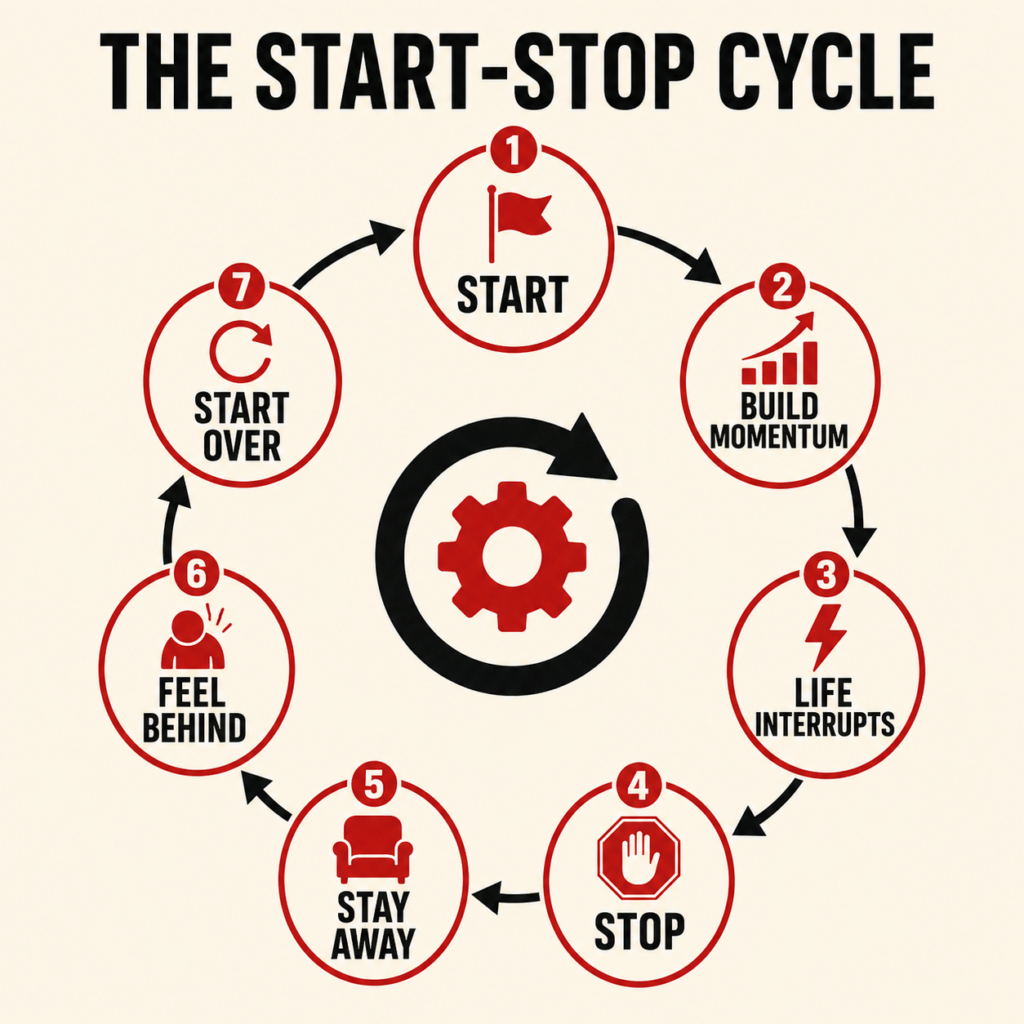
Start → Build Momentum → Get Interrupted → Stop → Stay Away → Feel Behind → Start Over
Then you do it all over again.
That’s how someone can be “building a business” for several years and still feel like they’re constantly standing at the starting line.
So instead of only asking:
“How can I force myself to be more consistent?”
I’d ask a different question:
“What keeps causing me to stop, and what can I change so it’s easier to keep going?”
That’s a much more useful question.
Let’s start there.
1. Be Consistent With the Right Work
This was one of my biggest mistakes when I first started.
Remember those 15-minute and 30-minute pockets I was squeezing into my evenings?
At the time, I thought I was being pretty productive with them.
Looking back…
Not so much.
I spent an enormous amount of that precious time learning.
Webinars.
Trainings.
Courses.
Then more webinars.
I took reams of notes.
Pages and pages about sales, marketing, lead generation, and how to build an online business.
Then I would take those notes, stuff them into my desk drawer, and eagerly wait for the next opportunity to learn something new.
Boy, was I feeling smart.
At least I thought I was.
I was becoming very book smart about marketing.
I knew terminology.
I understood strategies.
I could explain concepts.
What I didn’t have was much street smarts.
And you know how you get street smarts in business?
By going out into the street.
Not literally. 😂
I mean by actually doing the work.
Trying something.
Sending the email.
Creating the content.
Talking to people.
Making an offer.
Seeing what happens.
Making mistakes.
Adjusting.
Trying again.
My problem wasn’t that I wasn’t spending time on my business.
I was spending too much of my limited time preparing to do business instead of actually doing business.
Eventually, I hired a coach who was much more successful than I was.
After watching me “work” for a while, he finally confronted me about something I probably needed to hear.
I was doing plenty of activity.
But not nearly enough activity that had much chance of producing income.
Then he said something I’ve never forgotten:
“All those notes in your desk drawer? Those are uncashed checks.”

Boom!
That hit me like a ton of bricks.
Because he was absolutely right.
I had spent all this time acquiring information that could potentially help me produce results.
But I wasn’t cashing the checks.
I wasn’t implementing enough of what I had learned.
That conversation changed the way I looked at productivity.
Learning wasn’t my problem.
Implementing was.
My First 10 Email Subscribers
Not long after that conversation, I created a simple lead magnet to begin building my email list.
The old me probably would have created the lead magnet, put it online, and then gone looking for another webinar about how to build an email list.
This time I did something different.
I implemented.
Each evening, I spent some of my limited business time reaching out through Facebook Messenger to people I genuinely thought might be interested in the free resource I had created.
One person subscribed.
Then another.
Then another.
Eventually I had my first 10 email subscribers.
Ten subscribers isn’t going to make anybody’s Internet marketing highlight reel.
But to me, those 10 people represented something much bigger.
I had finally cashed one of those checks.
Instead of continuing to learn about building an email list, I had actually started building one.
That was the shift.
Not:
“I know how this works.”
But:
“I’m going to go do it.”
That’s where results begin.
The tactics we use in business will change.
They always do.
But this principle doesn’t:
Knowledge starts becoming valuable when you put it into motion.
What Actually Moves Your Business Forward?
Today, I like to identify what I call my Most Impactful Activities, or MIAs.
Those are the activities most directly connected to whatever result your business currently needs.
Your MIAs may involve attracting attention, generating leads, building relationships, making offers, serving customers or producing sales.
Your specific activities may be completely different from mine.
That’s okay.
The important point is this:
Before you worry about becoming more consistent, make sure you’re becoming consistent with the right things.
You can faithfully spend an hour every evening organizing files, tweaking graphics, and watching another training.
You may become wonderfully consistent.
Your income may remain wonderfully unchanged.
Busy and impactful aren’t the same thing.
And if you only have an hour, 30 minutes, or even 15 minutes available, that distinction becomes even more important.
2. Make the Important Work Small Enough to Fit Your Life
Once you know what matters, the next step is making the work easier to execute.
Suppose one of your important activities is email marketing.
You put this on your to-do list:
Write newsletter.
Sounds simple enough.
Except “write newsletter” is really a bunch of different things.
You need an idea.
A hook.
A subject line.
An opening.
The body.
A call to action.
Maybe some links.
Then you have to edit the whole thing.
Now imagine you’ve got 15 minutes.
“Write newsletter” suddenly feels pretty big.
So make the move smaller.
Maybe your 15-minute move is:
Write three possible subject lines.
Or outline the email.
Or write the first 200 words.
Or decide which story you’re going to tell.
You’re not making the business less important.
You’re simply making the action easier to execute inside the time you actually have.
That’s where one of my favorite principles comes in:
Don’t shrink the importance. Shrink the execution.
A 15-minute action doesn’t have to be trivial.
It just needs to be specific enough to start and small enough to finish.
That’s how little pockets of time can become real forward movement.
3. Build a Business Floor for Your Worst Days
Most business plans are created for your best days.
I call the guy who lives in those plans Ideal-Day Bob.
Ideal-Day Bob sleeps beautifully.
He wakes up refreshed.
Nobody needs anything from him.
There are no emergencies.
His computer works.
His calendar behaves.
His family behaves.
Even the dog behaves.
Ideal-Day Bob can follow just about any business plan.
Unfortunately, Real-Life Bob shows up a lot more often.
So instead of only asking:
“What should I accomplish on a good day?”
I want you to ask another question:
“What can I still do on a really bad day?”
I call that your Business Floor.
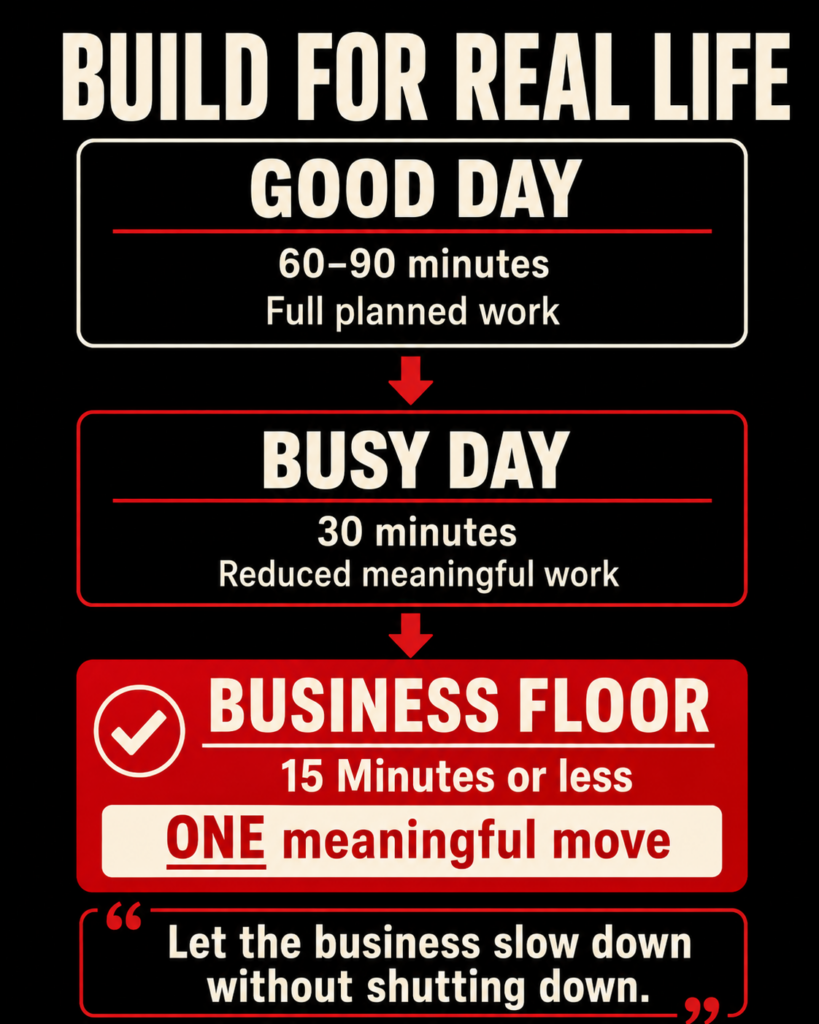
Your Business Floor is the smallest level of meaningful activity that keeps you connected to your business during those times when life is demanding most of your attention.
Maybe your normal business day is 60 or 90 minutes.
On a terrible day, your floor might be one follow-up.
One email.
One offer.
One paragraph.
One piece of content.
Or maybe 15 focused minutes moving your most important project forward.
Is that enough to build your entire business?
Of course not.
That’s not what your Business Floor is for.
The Business Floor gives your business a way to slow down without completely shutting down.
I was reminded of exactly how important that can be very recently.
When Business Had to Take a Back Seat
My daughter recently experienced serious complications after surgery that required additional procedures and hospital care.
My wife and I flew to Pennsylvania to help her sort everything out and get a medical team in place that we felt comfortable with.
It was an intense five days.
Business was nowhere near the top of my priority list.
Frankly, I rarely even thought about it.
But when I did, I found it strangely comforting to know that I already had my Business Floor in place.
I didn’t have to think:
“How in the world am I going to keep up with everything while all of this is happening?”
I wasn’t going to keep up with everything.
That wasn’t the goal.
For those five days, my business plan was about as simple as a business plan can get.
One meaningful business activity.
Fifteen minutes.
Then I was done.
That was it.
Some days my business barely moved.
But it did move.
And that made a huge difference to me.
There’s also good evidence that making progress on meaningful work, even relatively small progress, can positively affect motivation.
When I got home, I didn’t feel as if I had abandoned the business and now had to somehow drag myself back to the starting line.
I had simply slowed way down for a few days because something much more important needed my attention.
That’s exactly what a Business Floor is supposed to do.
Let your business slow down without shutting down.
There are going to be times when something else deserves your attention more than your business.
That’s real life.
Your business system should be able to handle it.
4. Decide Your Next Move Before the Time Pocket Shows Up
Here’s another consistency killer that I don’t think gets talked about enough.
You unexpectedly get 15 minutes.
Great!
You can work on your business.
So you sit down and ask:
“Okay… what should I do?”
You check your email.
Look at Facebook.
Open your notes.
Remember something you wanted to research.
Open ChatGPT.
Look at your task list.
Check something else.
And about 13 minutes later…
you’re still trying to decide what to do.
There goes the pocket. 😂
This is what I call decision friction.
That’s why I like having a 15-Minute Move Menu prepared ahead of time.
It’s simply a short list of meaningful activities you already know you can complete in a small pocket of time.
For example:
- For lead generation, follow up with two people or identify three possible prospects.
- For content, write the hook for tomorrow’s post or outline a short video.
- For email, create three subject lines or write the opening paragraph.
- For a larger project, complete one clearly defined piece of it.
Now you don’t have to invent productive work every time a little time opens up.
Even better, if you know you’re probably going to have 15 or 20 minutes tomorrow, decide tonight exactly what you’re going to do during that time.
There’s actually research behind this idea.
Psychologists call these kinds of pre-decisions implementation intentions, and research has found that they can improve the chances of following through on a goal.
I teach this very simply:
Don’t decide in the pocket. Execute in the pocket.
If you only have 15 minutes, the first 10 are far too valuable to spend figuring out what to do.
5. Learn the Difference Between Restarting and Resuming
This lesson became very personal for me early in my business.
When I first started my side business, I was excited about it.
So naturally, I told people.
My friends knew.
My coworkers knew.
My coworkers were especially skeptical.
Every once in a while, somebody would say something like:
“So… make any money in your big enterprise yet?”
Usually accompanied by that sarcastic little smile that told me exactly what they thought.
You know the kind.
I could handle that.
Then word eventually got back to my boss.
One day she called me into her office.
When I walked in, my blog was sitting there on her computer screen.
She proceeded to tell me how unprofessional she thought it was and essentially shamed me for wasting my time on it.
That got to me.
I stopped working on my business.
Completely.
Not for a day.
Not for a week.
For more than three months, I did virtually nothing.
I spent much of that time trying to decide whether I should continue at all.
Eventually I came to a pretty simple conclusion.
What I chose to do legally and ethically in my own spare time was my business.
So I decided to come back.
But something surprised me.
Coming back was hard.
I assumed making the decision to return would be enough.
It wasn’t.
I fell right back into some of my safest old habits.
More webinars.
More learning.
More busy work.
Lots of activities that allowed me to tell myself I was working on my business without forcing me to do much of the uncomfortable work that might actually produce results.
Looking back, that experience taught me something I’ve never forgotten:
Deciding to come back and knowing how to come back are two different things.
That’s one of the reasons I now teach what I call the Resume Rule.
Don’t Start Over. Resume.
Miss a few days?
Resume.
Gone two weeks?
Resume.
Family emergency?
Resume.
Vacation?
Resume.
Bad month?
Resume.
You don’t need some dramatic comeback ceremony.
You don’t need a completely new business plan.
You don’t have to make up every task you missed.
And you certainly don’t need to punish yourself because life happened.
Ask yourself one question:
What is the next meaningful move I can make from where I am right now?
Then make it.
One move.
Not twelve.
Your business doesn’t care how dramatic your comeback is.
It cares whether you came back.
And there’s one other lesson I learned the hard way.
A comeback only changes your results if something about the way you come back changes too.
If you disappear for three months and return to the exact same habits that weren’t producing results before you left, simply coming back isn’t going to fix much.
I know.
I tried it.
If you’ve already been away from your business for a while, I wrote a separate guide on how to restart your business after losing momentum without making the mistake of starting over.
What Should You Do If You Haven’t Worked on Your Business for Weeks?
If you’ve already fallen completely out of your routine, I would not begin by creating another huge plan.
Start smaller.
First, look at where you stopped.
What were you working on? What was unfinished?
Next, ask what matters now.
Not everything you missed.
Not the giant list of things you think you should have done.
What matters now?
Then choose one small but meaningful move.
And here’s the important part.
Do that move before you spend two hours planning your big comeback.
Because movement comes before momentum.
Once you’ve taken one meaningful action, choose another.
Then another.
Remember, you’re not really starting from Day One again.
You have experience.
Knowledge.
Contacts.
Assets.
And probably quite a few lessons you didn’t have when you first began.
You’re not starting over. You’re starting from where you are.
Why Motivation Is a Terrible Business System
I love motivation.
It feels great.
When you’ve got it, use it.
But I wouldn’t build my business around needing it.
Motivation comes and goes.
Some mornings you wake up ready to conquer the world.
Other mornings you would prefer that the world leave you alone until after lunch. 😂
That’s why systems matter.
Your business needs to know the answers to some basic questions before you’re tired, busy, or discouraged.
What matters most?
What’s the smallest meaningful version of that work?
What can I do on a terrible day?
What’s my next move?
What do I do after I’ve been away?
The more often those questions already have answers, the less emotional energy you need just to get started.
And that makes consistency a whole lot easier.
Not because you suddenly became more motivated.
Because you removed some of the friction that kept stopping you.
How Can I Stay Consistent in Business While Working Full-Time?
If you’re trying to build a side business around a full-time job, one of the biggest mistakes you can make is trying to run your part-time business like someone else’s full-time business.
You simply don’t have the same number of hours.
That means you have to become more selective.
Figure out which activities really matter.
Prepare meaningful work that can fit into smaller pockets.
Use larger blocks when they’re available.
Create a Business Floor for difficult days.
And please stop comparing yourself with somebody whose life looks nothing like yours.
When I was spending 12 to 15 hours in the IVF laboratory, there were evenings when 15 to 30 minutes was reality.
Pretending I had three hours didn’t magically create three hours.
Learning how to use the 30 minutes I actually had was far more useful.
Build around your actual capacity, not your imaginary capacity.
Is 15 Minutes a Day Enough to Build a Business?
By itself?
Probably not.
And I don’t want to mislead you.
A real business eventually requires a meaningful amount of work.
But that’s not the point of a 15-minute move.
Those small pockets help you use time that might otherwise disappear.
They help keep larger projects moving.
And during difficult periods, they can keep you from disappearing from your business completely.
Think of 15 minutes as a tool.
Not a magic formula.
Some days you may have 15 minutes.
Another day you may have an hour.
Maybe Saturday morning you have three hours.
A flexible business learns how to make good use of all three.
What If I Don’t Know What to Work On First?
Start with impact.
Ask yourself:
If I could complete only one meaningful business activity today, which one would most directly help move my business forward?
I think that’s a much more useful question than:
“What do I feel like doing?”
Or:
“What’s easiest?”
Or even:
“What’s at the top of my giant to-do list?”
Sometimes the best answer will involve generating leads.
Sometimes following up.
Sometimes making an offer.
Sometimes serving an existing customer.
Sometimes creating content.
Sometimes finishing a project that has been hanging over your head for weeks.
The answer will be different depending on your business and where you are right now.
But learning to identify your highest-impact work is one of the most valuable skills a busy entrepreneur can develop.
Limited time makes priorities more important, not less.
Why Do I Keep Losing Momentum in My Business?
This is where we have to get underneath the tactics.
Two people can stop working on their businesses for completely different reasons.
One gets overwhelmed.
One overthinks everything.
One starts strong, tries to do way too much, and burns out.
One begins doubting whether they can succeed.
One keeps learning instead of implementing.
One avoids the most important activities because they’re uncomfortable.
And another keeps telling themselves they’ll really get serious about the business when life finally calms down.
They can all end up in exactly the same place.
The business stops.
But the reason underneath that stop can be completely different.
That’s why I don’t believe there is one universal answer to consistency.
Sometimes the first thing you need to do is identify the pattern that keeps knocking you off track.
Because once you recognize your pattern, you can start catching it sooner.
And if you catch it sooner, you’ve got a much better chance of stopping three lost days from turning into three lost months.
One more thing…
If this keeps happening and you find yourself stopping over and over, there may be something deeper going on.
I wrote more about why you may keep giving up on your business here.
Need Help Turning This Into Daily Action?
Knowing you need to be more consistent is one thing.
Figuring out what to actually do when you sit down to work is another.
Especially when your time is limited.
 That’s why I created my Stupid Simple Daily Action Guide.
It’s a simple resource to help you cut through the noise, focus on meaningful activity, and keep your business moving forward without feeling like you have to do everything at once.
Get the Free Daily Action Guide
Use it to help you decide what deserves your attention, take meaningful action, and make the most of whatever business time you have available.
The Real Secret to Staying Consistent in Business
You don’t need a perfect streak.
You don’t need to work seven days a week.
You don’t need a life where nothing ever goes wrong.
And you probably don’t need another motivational speech.
What you need is a business that’s resilient enough to operate inside real life.
You need to know what work matters.
You need to turn learning into implementation.
You need to be able to make important work smaller when necessary.
You need a Business Floor for the really bad days.
You need to know your next move before the little pocket of time appears.
And when life knocks you away from your business, you need to know how to come back.
That’s what consistency looks like to me today.
Some weeks you’ll move quickly.
Some weeks you’ll move slowly.
And sometimes something in your life is going to become much more important than your business for a while.
That’s okay.
Your goal isn’t to make every day look exactly the same.
Your goal is to stop treating every interruption like the end.
So the next time you fall off track, don’t waste a bunch of energy telling yourself you’ve failed again.
Look at where you are.
Find one meaningful move.
Do it.
Then find another.
Don’t restart.
Resume.
Frequently Asked Questions About Staying Consistent in Business
Why is it so hard to stay consistent in business?
It can be hard to stay consistent in business when your plan requires more time, energy or motivation than your real life reliably gives you.
Other common reasons include overwhelm, overthinking, working on activities that don’t produce meaningful results, discouragement and not knowing exactly what to do next.
A good business system needs to work on difficult days too, not just ideal ones.
How do I become more consistent in my business?
Start by identifying the activities that have the greatest impact on your business.
Break larger activities into smaller moves that are easier to complete. Decide important next actions ahead of time and create a minimum Business Floor for difficult days.
Just as importantly, have a simple way to resume after an interruption instead of continually starting over.
How can I stay consistent while working a full-time job?
Build your business around the time you actually have.
Focus on your highest-impact activities, prepare 10- to 15-minute actions for smaller pockets of time, and use larger blocks when they become available.
Don’t expect your part-time business schedule to look like the schedule of someone who works on their business full-time.
What should I do when I lose motivation for my business?
Try to rely less on motivation and more on knowing what your next move is.
Decide in advance which activities matter and identify a small action you can take even when your enthusiasm is low.
Motivation is useful when you have it, but a good system helps you continue when you don’t.
How do I restart my business after taking a break?
Don’t try to catch up on everything you missed.
Look at where you stopped, decide what matters most right now, and complete one meaningful action. Then choose the next one.
Think of it as resuming your business instead of starting over from Day One.
Is working 15 minutes a day enough to grow a business?
Fifteen minutes a day probably isn’t enough by itself to build most businesses over the long term.
But short work sessions can be extremely valuable.
They can help maintain continuity, use time that would otherwise be wasted, and keep important projects moving during unusually busy periods.
Use those small pockets along with larger blocks of focused work whenever your schedule allows.
How do I know what to work on first in my business?
Ask which activity would have the greatest direct impact on what your business needs most right now.
Depending on your situation, that might be generating leads, following up, making offers, serving customers, creating content, or finishing an important project.
Choose based on impact, not simply what feels easiest to do.
Want Help Deciding What to Work On Next?
If you’re trying to stay consistent but still find yourself wondering what deserves your attention each day, my free Daily Action Guide can help.
It’s designed to help you focus on meaningful action, make better use of limited time, and keep your business moving forward without trying to do everything at once.
It's Your Time to SHINE!

Dr. Bob Clarke
Email: Bob@BobandRosemary.com
Join The Second Income Society
A free tribe for Busy Entrepreneurs
This post may contain affiliate links to products or services I trust. If you make a purchase using these links, I may receive a commission at no extra cost to you. Thank you for the support!