
You haven’t really worked your business in a while.
Maybe it’s been a week.
Maybe a month.
Maybe longer.
And somewhere in the back of your mind, you know you need to get going again.
So you make a decision.
Monday!
Monday, you’re getting serious.
Monday, you’re going to start posting again.
Get back to your emails.
Finish the project you abandoned.
Follow up with people.
Fix the website.
Get organized.
Maybe you’ll even make a brand-new schedule.
Because nothing says “THIS TIME I’M SERIOUS” quite like a new schedule. 😂
There’s just one problem.
You may not need to restart your business at all.
You may just need to resume it.
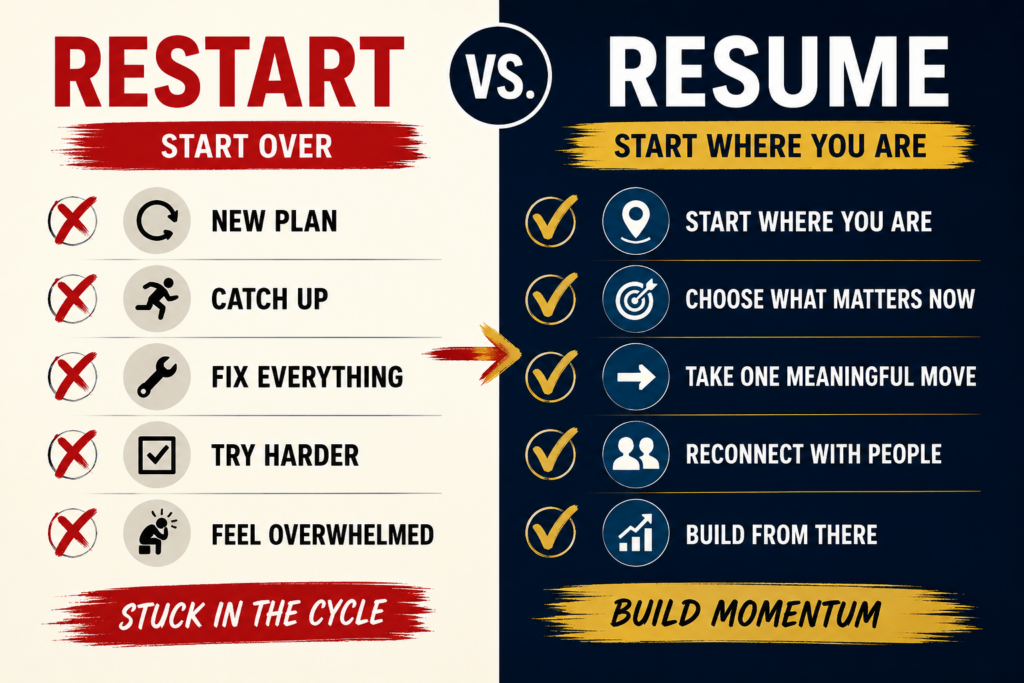
That’s a very different way of thinking.
Because when we tell ourselves we’re “starting over,” it feels like we’re back at Day One.
But you’re not at Day One.
You’ve already learned things.
You’ve made mistakes.
You’ve probably built some assets.
Maybe you have an email list.
Some content.
Customers.
Contacts.
A website.
A social media following.
You know more than you did when you originally started.
So why throw all of that away mentally and act like you’re beginning from scratch?
You’re not.
You’re starting from where you are today.
And that’s exactly what I want to help you do.
Why Is It So Hard to Restart Your Business?
You’d think coming back would be easy.
You’ve done this before.
You know the business.
You know what needs to be done.
So just get started again, right?
If only it worked that way.
There are all kinds of reasons restarting can feel difficult.
You may look at everything you didn’t do while you were away and feel hopelessly behind.
You may have lost your routines.
You may not know what deserves your attention first.
You may feel guilty because you disappeared.
Maybe you’re embarrassed that this isn’t the first time you’ve stopped.
Or maybe the thing that caused you to stop in the first place is still there.
That last one is important.
Because if nothing changes in how you’re building your business…
you can restart…
and end up stopping for exactly the same reason again.
That’s how the cycle starts.
You work.
You build momentum.
Something happens.
You stop.
You stay away.
Eventually you feel bad enough about being away that you decide to start again.
Then you repeat the whole thing.
So before you worry about getting motivated again, I want you to do something more useful.
I want you to figure out how to come back differently.
1. Stop Trying to Catch Up
This is probably the first thing I’d tell you if we were sitting across the table talking about your business.
Stop trying to catch up.
You can’t.
And you don’t need to.
Let’s say you haven’t really worked your business for the last month.
During that month, you planned to:
- Write four emails.
- Create eight Facebook posts.
- Record six videos.
- Finish your lead magnet.
- Follow up with ten people.
- Update your website.
- Start a new funnel.
- And finally finish that course you bought six months ago.
Now you’re back.
So naturally, you put ALL of those things on your comeback list.
That ought to make restarting feel easy, right?
Wrong.
Look at that list! No wonder you don’t want to begin.
You’re trying to carry the entire month you missed into today.
Don’t.
Some of those things still matter.
Some can wait.
And some probably don’t matter anymore.
The Comeback Purge
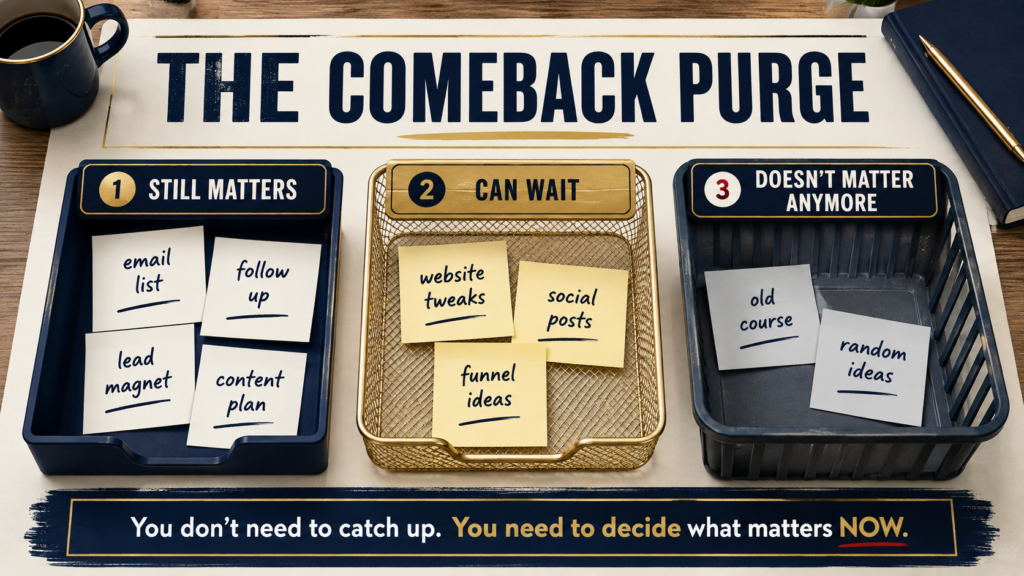
I recommend you do what I call a simple Comeback Purge.
Take everything you think you need to catch up on and put it into three categories:
1. Still Matters
2. Can Wait
3. Doesn’t Matter Anymore
Be ruthless with that third category.
You’re not required to complete something just because three weeks ago you thought you should.
Business changes.
Priorities change.
You change.
You don’t need to catch up.
You need to decide what matters NOW.
That’s a much smaller problem to solve.
2. Figure Out Why You Stopped
This is where most comeback plans go wrong.
You focus completely on:
How do I get started again?
But there’s another question that may be even more important:
Why did I stop?
That answer can tell you a lot.
Did life genuinely interrupt you?
Did you overwhelm yourself?
Were you trying to do too many things?
Did you lose confidence because your efforts weren’t producing results?
Did you get confused about what to work on?
Were you spending most of your time learning instead of implementing?
Did you burn yourself out?
Were you avoiding something uncomfortable?
Did you keep telling yourself you’d get serious when life finally calmed down?
There’s no shame in any of those answers.
You’re looking for information.
Because here’s the problem:
If the reason you stopped hasn’t changed, restarting the exact same way probably produces the exact same result.
And if stopping has become a repeated pattern for you, this may help: Why Do I Keep Giving Up on My Business?
I learned that one the hard way.
Early in my online business, I was excited about what I was building.
So naturally, I told people.
Friends.
Coworkers.
Probably anybody who’d listen. 😂
My coworkers weren’t exactly impressed.
Every once in a while, someone would say something like:
“So… make any money in your big enterprise yet?”
Usually accompanied by that sarcastic smile.
You know the one.
Eventually, word about my side business got back to my boss.
One day she called me into her office.
When I walked in, my blog was sitting there on her computer screen.
She proceeded to tell me how unprofessional she thought it was and basically shamed me for wasting my time.
That got to me.
A lot.
I stopped working on my business.
Completely.
For more than three months, I did virtually nothing.
Eventually I decided I wasn’t going to let someone else decide what I could legally and ethically do with my spare time.
So I came back.
But here’s what surprised me.
Coming back was HARD.
I thought deciding to return would be enough.
It wasn’t.
And because I hadn’t really examined what was going on underneath the surface, I slipped right back into my safest old habits.
- Webinars.
- Training.
- Learning.
- Busy work.
Things that allowed me to feel productive without forcing me to do much of the uncomfortable work that might actually produce results.
That experience taught me something I still believe today:
Deciding to come back and knowing HOW to come back are two different things.
So before you build your comeback plan, look backward for a minute.
Not to beat yourself up.
To learn.
What knocked you off track?
And what needs to be different this time?
If This Keeps Happening to You…
 If this isn’t the first time you’ve stopped and had to find your way back, the problem may be bigger than simply needing another restart.
That’s exactly why I created UNSTUCK: The Comeback Workshop.
It helps you identify what’s underneath your start-stop cycle, rebuild some of the belief you may have lost along the way, and create a realistic plan for keeping your business moving even when real life gets in the way.
3. Don’t Rebuild Your Whole Business
When you’ve been away for a while, everything starts to look important.
Your website needs attention.
Your email list needs attention.
Social media needs attention.
Your funnel needs attention.
Your offer needs attention.
Your content needs attention.
YOU need attention.
So where do you start?
I’d start with one question:
If I could accomplish only ONE meaningful thing in my business right now, what would help me regain traction?
Not ten things.
One.
I call these my Most Impactful Activities, or MIAs.
An MIA is simply an activity that has a real chance of moving your business toward what it needs most right now.
That might mean generating leads.
- Making an offer.
- Following up.
- Finishing something important.
- Serving a customer.
- Sending an email.
- Or starting a conversation.
And I want to emphasize that last one.
Because one of the easiest things to do when you come back to your business is to hide behind the scenes.
Fix things.
Organize things.
Build things.
Learn things.
All while avoiding people.
But businesses are built around people.
Someone has to see you.
Respond to you.
Talk with you.
Trust you.
Eventually, some of those people buy something.
So don’t assume your first comeback move needs to be rebuilding your website or creating another piece of content.
Maybe it’s simply:
- Email your list.
- Follow up with someone who showed interest.
- Reconnect with a former customer.
- Start two genuine conversations.
That may create more momentum than spending three hours rearranging your homepage.
Not Sure What Your Next Move Should Be?
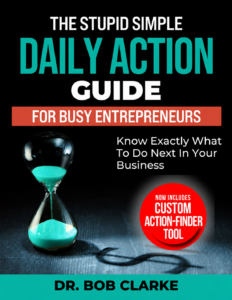 When you’ve been away from your business, EVERYTHING can suddenly feel important.
That’s exactly why I created my free Daily Action Guide For Busy Entrepreneurs.
It’ll help you cut through the noise, figure out what deserves your attention, and choose one meaningful action you can actually take.
4. Make Your First Move Almost Too Small to Fail
Here’s another mistake I’ve made.
You’ve been away.
You feel guilty.
So you decide you’re going to make up for lost time.
Starting tomorrow:
- Two hours a day.
- Seven days a week.
- Thirty social posts.
- Three emails.
- A new funnel.
- Daily videos.
Slow down.
Your first job isn’t to prove how serious you are.
Your first job is to move.
So take whatever important activity you identified and make the first move small enough that you’ll actually do it.
If you need to reconnect with your email list…don’t build a 12-email campaign.
Write Email #1.
If you need more leads… don’t create an entire lead-generation system.
Start two conversations.
If you need more content… don’t build a 30-day content calendar.
Publish one useful post.
If there’s a big project you abandoned… don’t finish the entire project today.
Complete the next piece.
This is something I teach a lot:
Don’t shrink the importance. Shrink the execution.
There’s actually research behind this idea.
Psychologists call these kinds of specific action plans implementation intentions, and they’ve been shown to help people follow through on goals instead of getting stuck at the intention stage.
Your first move should matter.
But it doesn’t have to be huge.
5. Reconnect Before You Rebuild
If you’ve been away from your business for a while, your first instinct may be to create things.
New content.
New funnels.
New lead magnets.
New systems.
Sometimes that’s exactly what you need.
But often, I’d do something else first.
Reconnect.
If you have an email list, email them.
If someone was interested in what you offered before you disappeared, follow up.
If a customer hasn’t heard from you in a while, check in.
If people are responding to your content, talk to them.
If someone comments on something you post, don’t just hit the Like button.
Start a conversation.
Years ago, after a coach pointed out that I was doing far too much learning and not enough implementing, I created a simple lead magnet.
The old version of me might have created it, put it online, and then watched another webinar about how to build an email list.
Instead, I reached out to people who I genuinely thought might find the resource useful.
That created conversations.
Some of those conversations turned into subscribers.
Eventually I got my first 10 email subscribers.
Ten. Not 10,000. Ten.
But those 10 people mattered because something had changed.
I was no longer learning about building an email list.
I was building one.
That’s why I think conversations are so important when you’re trying to regain momentum.
Conversations bring your business back into contact with the real world.
- Someone responds.
- Someone asks a question.
- Someone shows interest.
- Someone tells you what they’re struggling with.
- Maybe someone buys.
Suddenly your business isn’t just you sitting alone staring at your computer again.
Something is happening.
And something happening creates momentum.
6. Don’t Wait Until You Feel Motivated
You may be waiting to feel the way you felt when you first started.
Excited.
Motivated.
Optimistic.
Ready to go.
You might.
But I wouldn’t wait for it.
Because sometimes motivation shows up AFTER you start moving.
You send an email.
Somebody replies.
You publish a post.
Someone comments.
You follow up.
Someone wants to know more.
You finish something that’s been hanging over your head for a month.
And suddenly you feel a little different.
You’ve got proof.
Something happened.
That’s important.
Because progress can begin rebuilding belief.
That’s exactly what my first 10 subscribers did for me.
Ten subscribers wasn’t a huge business result.
But it proved something.
I could create something.
Put it in front of people.
Have conversations.
And get people to respond.
That little bit of proof made the next move easier.
So if you’re sitting around waiting to feel motivated enough to restart your business, try reversing the order.
Move first.
Motivation may catch up.
7. Give Yourself Seven Days to Get Moving Again
I wouldn’t create a 90-day comeback plan on your first day back.
You can do that later if you need one.
For now, give yourself one week.
Not seven perfect days.
Just seven days to get reconnected with your business.
During those seven days, I’d focus on a few things.
- Clear out the old backlog.
- Choose what matters now.
- Complete one or two Most Impactful Activities.
- Reconnect with actual people.
- Finish something.
Notice which activities create movement.
And by the end of the week, decide what deserves your attention next.
That’s enough.
You’re not trying to rebuild the entire business in seven days.
You’re trying to rebuild motion.
Because once you’re moving again, you’re in a much better position to decide where you want to go.
8. Build Differently This Time
This may be the most important part of the entire article.
Coming back is good.
But if you come back and rebuild the exact same business routine that caused you to stop before…
What do you think is likely to happen?
You’ll probably stop again.
So ask yourself:
What needs to be different this time?
Maybe you need fewer priorities.
Maybe you need smaller actions.
Maybe you’ve been learning way too much and implementing way too little.
Maybe you need to spend more time talking with people.
Maybe you need a clearer idea of what actually moves your business.
Maybe you need to stop trying to work your part-time business like somebody else’s full-time business.
Maybe you need a plan for what happens when life inevitably interrupts you again.
That last one matters a lot.
Because it WILL happen.
A family emergency.
Work gets crazy.
You get sick.
You travel.
Something breaks.
Life doesn’t care about your content calendar.
So instead of hoping nothing interrupts your comeback…
Build your comeback expecting that something eventually will.
A comeback only changes your results if something about the way you come back changes too.
This is really the heart of what I teach inside UNSTUCK: The Comeback Workshop.
Coming back matters.
But learning how to build differently so you don’t keep repeating the same cycle matters even more.
9. Create a Business Floor Before You Need It
One of the things I wish I understood years ago is that you need a plan for your bad days, not just your good ones.
I call that your Business Floor.
Your Business Floor is the smallest meaningful amount of business activity you can do when life temporarily has other plans for you.
Maybe it’s 15 minutes.
One email.
One follow-up.
One conversation.
One paragraph.
One meaningful move.
The goal isn’t to grow your entire business on your Business Floor.
The goal is to keep your business from disappearing completely every time life gets messy.
I wrote an entire article about this idea and how to build your business around real life rather than perfect conditions.
Read: How to Stay Consistent in Business When Life Keeps Getting in the Way
The important thing for your comeback is this:
Don’t wait until the next interruption happens to decide what you’ll do.
Decide now.
10. Stop Restarting. Resume.
This is the mindset shift I wish I’d learned much earlier.
You miss three days?
Resume.
You disappear for two weeks?
Resume.
You haven’t worked your business in three months?
Resume.
You don’t need to wipe the board clean.
You don’t need a dramatic announcement.
You don’t need to make up everything you missed.
You don’t need to punish yourself.
And you definitely don’t need another brand-new notebook.
Okay, maybe you WANT a new notebook.
I get it. 😂
But you don’t NEED one.
Ask yourself:
What is the next meaningful move I can make from where I am right now?
Then do that.
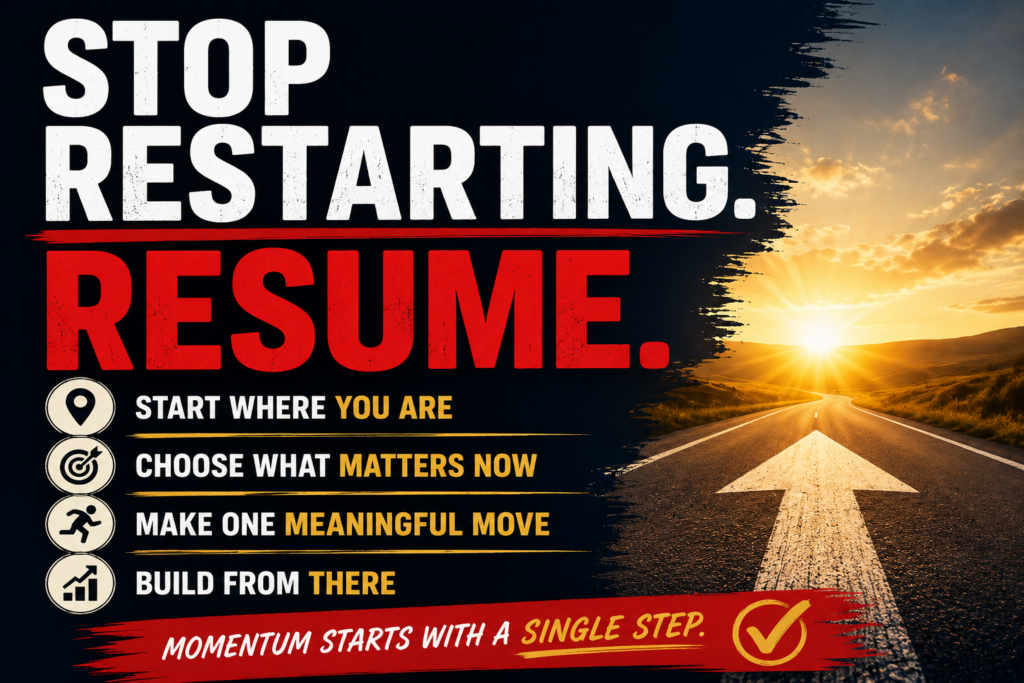
That’s your comeback.
Your business doesn’t care how dramatic your return is.
It cares whether you came back.
What If You’ve Ignored Your Business for Months?
The longer you’ve been away, the more intimidating coming back can feel.
But the basic process really doesn’t change.
Don’t try to recreate the exact business you left months ago.
Look at what exists today.
What assets are still useful?
What relationships still matter?
What offer still makes sense?
What no longer deserves your attention?
What’s the most important problem your business needs to solve right now?
Then choose one meaningful action.
You may discover that your comeback is less about restoring the old business and more about deciding which pieces deserve to come forward with you.
That’s okay.
You’re allowed to leave some things behind.
Should You Create a New Business Plan?
Maybe.
But probably not on Day One.
If your old direction no longer makes sense, then yes, you may need a new plan.
But if the real problem is simply that you stopped executing, another planning session may be exactly what you DON’T need.
Sometimes planning is productive.
Sometimes it’s procrastination wearing glasses.
If you already know what needs to happen next, do that first.
Get moving.
Then plan from a position of motion instead of paralysis.
What Should You Work on First When Restarting Your Business?
Start with impact.
Ask:
If I could complete only one meaningful activity today, what would most directly help my business move forward?
Depending on your business, the answer might be:
- Generate leads.
- Reconnect with your audience.
- Follow up with prospects.
- Start conversations.
- Make an offer.
- Serve an existing customer.
- Publish useful content.
- Finish an important project.
There’s no universal answer.
But there is usually something more important than everything else.
Find it.
Do it.
Then choose the next move.
How Do You Regain Momentum in Your Business?
You don’t regain momentum by thinking about momentum.
You regain it by moving.
One action.
Then another.
And another.
Some of those actions will produce small results.
Proof helps rebuild confidence.
Confidence makes the next action easier.
And little by little, you stop feeling like someone trying to restart a business…
and start feeling like someone who’s running one again.
That’s the goal.
The Real Goal Isn’t Starting Again
If you’ve been away from your business, of course I want you to come back.
But I don’t want you to just restart.
I want you to learn something from what happened.
Clear out what no longer matters.
Figure out why you stopped.
Choose the work that matters now.
Make the first move smaller.
Reconnect with people.
Let action rebuild motivation.
Build a plan that works inside your real life.
Create a Business Floor.
And when you get interrupted again someday…
because you will…
don’t turn it into another giant restart.
Resume.
That’s what building a business for the long haul really looks like.
Not one uninterrupted streak of perfect productivity.
It’s moving.
Getting knocked off course.
Adjusting.
Coming back.
Learning.
And continuing.
So if you’ve been telling yourself:
“I really need to restart my business…”
Try changing the sentence.
“I’m ready to resume my business.”
Then ask:
What’s my next meaningful move?
And go make it.
Frequently Asked Questions About Restarting Your Business
How do I restart my business after taking a break?
Start by looking at what matters now rather than trying to catch up on everything you missed.
Identify why you stopped, choose one meaningful business activity and complete that first.
Think of the process as resuming your business rather than starting over from Day One.
How do I regain momentum in my business?
Momentum usually returns through action.
Start with one small but meaningful activity that can create movement, such as sending an email, following up, creating useful content, having a conversation or making an offer.
Small results can help rebuild both momentum and confidence.
What should I work on first when restarting my business?
Choose the activity most directly connected to what your business needs right now.
That might be generating leads, reconnecting with your audience, starting conversations, following up with prospects, making an offer or completing an important unfinished project.
How do I get motivated to work on my business again?
Don’t assume motivation has to come first.
Sometimes taking one meaningful action creates a small result, and that result helps motivation return.
Movement can come before motivation.
What if I haven’t worked on my business for months?
Don’t try to recreate everything exactly as it was.
Review what still matters, eliminate outdated priorities and decide what your business needs most today.
Then complete one meaningful action and build from there.
Should I create a new business plan when restarting?
Only if your direction or priorities have genuinely changed.
If you already know what your business needs, another planning session may delay the action that would actually help you regain momentum.
How do I reconnect with customers or prospects after taking a break?
Keep it simple and human.
Reach out, restart the conversation and show genuine interest in what’s happening with them.
You don’t need to pretend you were never away or turn the first interaction into a sales pitch.
How can I stop losing momentum in my business?
Look at what repeatedly causes you to stop.
Build around your actual time and capacity, focus on meaningful activities, break larger work into smaller moves and create a minimum Business Floor for periods when life gets especially demanding.
Need Help Figuring Out Your Next Move?
If you’re ready to get your business moving again but you’re still staring at everything wondering:
“Okay… what should I actually work on?”
That’s exactly why I created my free Daily Action Guide.
It’ll help you cut through the noise, identify what deserves your attention and turn it into one meaningful action you can actually take.
It's Your Time to SHINE!

Dr. Bob Clarke
Email: Bob@BobandRosemary.com
Join The Second Income Society
A free tribe for Busy Entrepreneurs
This post may contain affiliate links to products or services I trust. If you make a purchase using these links, I may receive a commission at no extra cost to you. Thank you for the support!
Recommended Resources To Jumpstart Your Business
The Stupid Simple Daily Action Guide For Busy Entrepreneurs - know what to do for your business every time you sit down at your computer... ahead of time!
UNSTUCK: The Comeback Workshop: A 4-session on-demand workshop for home-business owners tired of starting, stopping, and starting over. Discover what keeps derailing you and build a realistic system for consistent action.
How To Earn Your First $1000 Online - wouldn't it feel great to have more money coming IN each month than going OUT?
Crush Consistency NOW! - if you find yourself lacking consistency in your business, you must own this course!
The Second Income Society - a free tribe for busy entrepreneurs
The Part-Time Profit Machine - my signature course, a must-have resource for anyone building a business part-time.