
Why do I keep giving up on my business?
Maybe you’ve asked yourself this question before.
Maybe more than once.
You start your business.
You get excited. You make plans.
You’re going to be consistent this time.
You’re going to post.
Follow up.
Build your list.
Make offers.
Learn what you need to learn.
Finally, make this thing work.
And for a while, you do.
Then something happens.
Maybe the results don’t come as quickly as you hoped.
Maybe life gets busy. You get overwhelmed.
Maybe you start comparing yourself to people who seem to be moving a whole lot faster than you are.
Maybe you realize there’s something you need to do that you don’t really want to do.
Selling.
Following up.
Starting conversations.
Being visible.
And little by little, you pull away.
A day goes by.
Then a few days. Then a week.
Pretty soon, your business is sitting there waiting for you.
Again.
And eventually you start wondering:
Why do I keep doing this?
Why do I keep giving up?
That’s the question I want to explore with you.
Because I’m not convinced most people who repeatedly stop working their businesses are actually “quitters.”
I think something else is often going on.
You May Not Be Giving Up on Your Business
Here’s a question I want you to think about:
Are you giving up on the business, or are you trying to escape the way the business is making you feel?
Those aren’t the same thing.
Maybe the business is making you feel:
Frustrated. Behind.
Inadequate. Confused.
Embarrassed. Overwhelmed.
Rejected. Uncertain.
Disappointed.
And if every time you sit down to work on your business, you feel one or more of those things…
Stepping away can actually feel pretty good.
At least temporarily.
You don’t have to think about the lack of sales.
You don’t have to worry about what to post.
You don’t have to wonder why nobody is responding.
You don’t have to follow up.
You don’t have to face the possibility of somebody saying no.
You don’t have to feel like you’re failing.
So you step away.
And for a little while…
You feel relief.
That’s important.
Because if stopping gives you relief, your brain has just learned something.
Business feels bad. Stopping feels better.
That can become a very powerful pattern.
Until something else shows up.
Guilt.
The Stop, Relief, Guilt Cycle
This is where things can get really frustrating.
You stop working your business.
At first, you feel relieved.
Then a few days go by.
You start thinking about everything you should be doing.
You see somebody else succeeding.
You open your email and see another business success story.
You look at the course you bought.
You remember the goals you set.
And now the relief starts turning into guilt.
You begin telling yourself:
I really need to get going again.
So you get motivated.
You make another plan.
You come back.
You work hard for a while.
Then whatever caused you to stop the first time begins showing up again.
And the whole thing repeats.
It can look something like this:
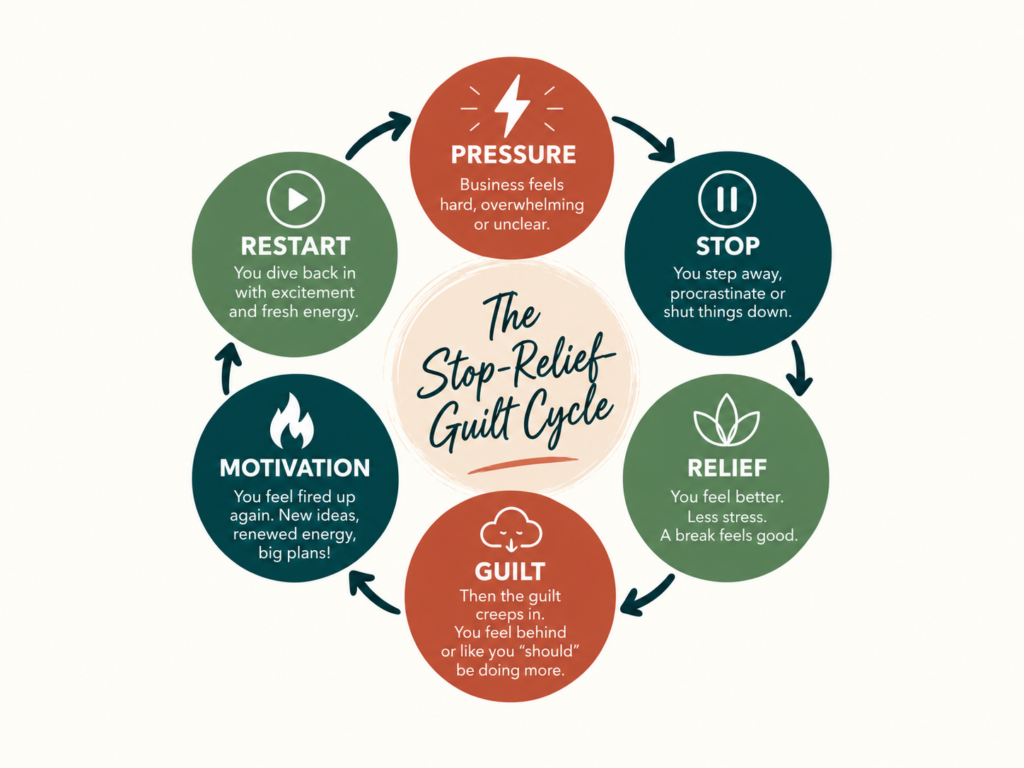
Pressure → Stop → Relief → Guilt → Motivation → Restart → Pressure
Over and over.
If that sounds familiar, your problem may NOT be motivation.
You may have what I call a start-stop pattern.
And if that’s true, the solution probably isn’t another motivational speech.
You need to understand what keeps triggering the stop.
What Usually Happens Right Before You Give Up?
This may be one of the most useful questions you can ask yourself.
Not:
Why am I so inconsistent?
Not:
What’s wrong with me?
And definitely not:
Why can’t I be more like everybody else?
Ask:
What usually happens right before I pull away?
That’s where the clues are.
For some people, it’s a lack of results.
For others, it’s overwhelm.
For someone else, it’s self-doubt.
Maybe it’s a difficult task.
Maybe it’s having to sell.
Maybe it’s not knowing what to do next.
Maybe it’s seeing other people succeed faster.
Maybe it’s life genuinely interrupting.
You’re looking for the moment where your business shifts from something you’re building into something you want to avoid.
That moment is important.
Because if you can recognize it sooner, you can start responding differently.
1. You’re Working Hard and Nothing Seems to Be Happening
This one can wear you down.
You’re posting.
You’re learning.
You’re creating things.
You’re trying.
And not much is happening.
No leads.
Few conversations.
No sales.
Maybe hardly any engagement.
At some point, you start asking:
What’s the point?
That’s when business activity begins feeling less like progress and more like proof that you’re not succeeding.
And that can get personal very quickly.
It stops being:
“This strategy isn’t working.”
And starts becoming:
“Maybe I’m not cut out for this.”
That’s a dangerous shift.
Because once business results start becoming evidence about your value or ability, every disappointing result carries a lot more emotional weight.
One bad post isn’t just a bad post.
It feels like proof.
One offer nobody buys feels like proof.
One email nobody responds to feels like proof.
And pretty soon, stopping feels safer than continuing to collect evidence against yourself.
But here’s the problem…
You may be drawing a much bigger conclusion than the evidence actually supports.
Sometimes a result simply means:
- Wrong message.
- Wrong audience.
- Wrong offer.
- Wrong timing.
- Not enough traffic.
- Not enough conversations.
- Not enough repetition.
- Not enough skill yet.
Those are business problems.
Not character verdicts.
2. You’re Doing Too Much and Eventually You Burn Out
This is another pattern I’ve seen over and over.
You decide you’re finally going to get serious.
And getting serious means… doing everything.
Post every day.
Email more.
Make videos.
Build the funnel.
Learn a new platform.
Follow up.
Work on the website.
Create a lead magnet.
Start a podcast.
Maybe cure world hunger on Thursday. 😂
You can maintain that pace for a while.
Until you can’t. Then you crash.
And because you’ve defined “working your business” as doing ALL of those things…
Doing less feels like failure.
So instead of slowing down… you stop.
That’s one of the reasons I believe so strongly in building a business around your real life.
You don’t need a plan that proves how ambitious you are.
You need a plan you can actually keep doing.
3. You Don’t Know What to Work On
This one sounds harmless, but it can stop a business cold.
You finally get some time.
You sit down.
And immediately you’re faced with 27 possibilities.
- Write an email?
- Post on Facebook?
- Make a video?
- Follow up?
- Fix the website?
- Work on your offer?
- Learn something?
- Update your funnel?
- Check your stats?
So you bounce around.
You start one thing.
Then another. Then another.
An hour goes by.
You’ve been busy.
But you’re not sure anything important actually got done.
Do that often enough and eventually the business starts feeling exhausting.
That’s why I teach my clients to identif their Most Impactful Activities, or MIAs.
Here's how you do that:
Ask yourself:
What does my business need most right now?
Attention?
Leads?
Conversations?
Offers?
Sales?
Then choose the activity most likely to move that result.
Not the activity that feels easiest.
Not the one that makes you feel productive.
The one that matters.
Before you make the work smaller, make sure it’s the right work.
Need Help Figuring Out What to Work On?
If part of your problem is sitting down to work and not knowing what deserves your attention first, my free Stupid Simple Daily Action Guide can help.
It’ll help you cut through the noise, identify your most important activity, and turn it into one meaningful move you can actually take.
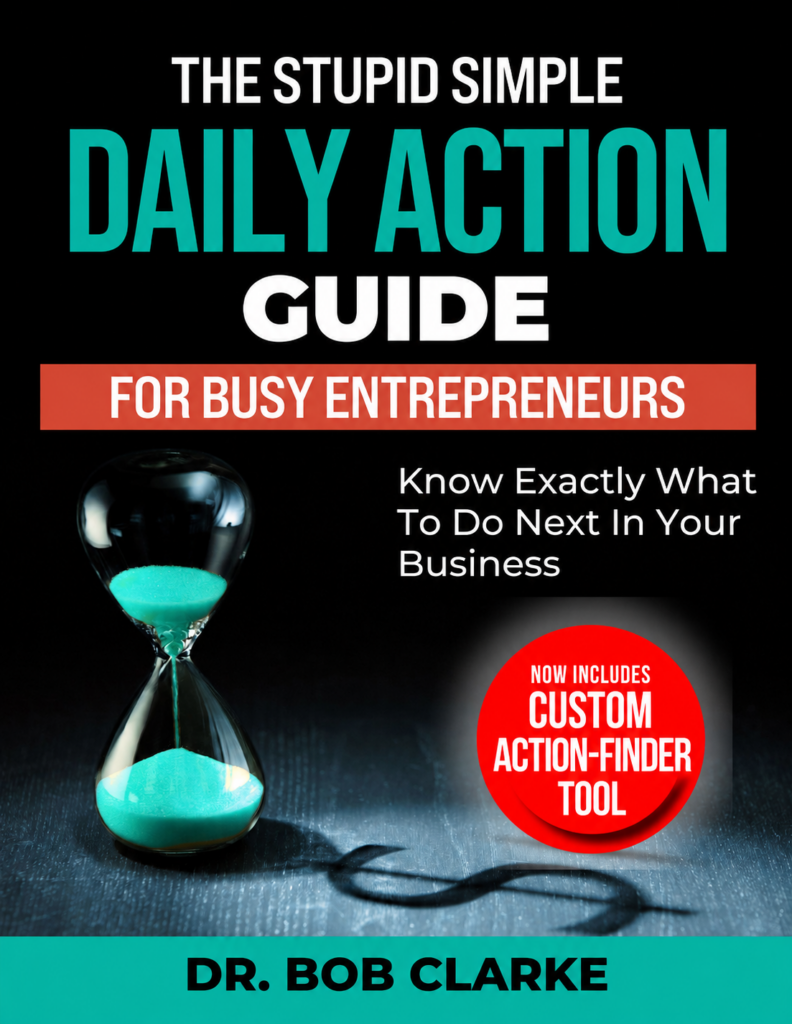
CLICK HERE TO GET THE FREE DAILY ACTION GUIDE.
4. You Keep Learning Instead of Implementing
I know this one well.
For years, I grew my business part-time while simultaneously working full-time in healthcare.
And while my time was very limited, I spent most of it… learning.
Attending webinars.
Buying courses.
Watching trainings.
Taking notes.
Lots and lots of notes.
I was becoming pretty knowledgeable about sales and marketing.
The problem was…
I wasn’t implementing nearly enough of it.
Eventually, a coach I hired looked at what I was doing and told me:
“All those notes in your desk drawer? Those are uncashed checks.”
That hit me like a ton of bricks.
Because he was right.
Learning feels safe.
Implementation doesn’t always feel safe.
Learning doesn’t reject you.
Learning doesn’t ignore your email.
Learning doesn’t say no to your offer.
Learning doesn’t make you wonder whether people like what you have to say.
Implementation does.
So sometimes “I need to learn more” is really:
“I’m not ready to risk finding out what happens.”
And if you’re not careful, learning becomes a very respectable form of avoidance.
There’s nothing wrong with learning.
You need skills.
But sooner or later, the knowledge has to leave the notebook.
You have to cash the check.
Here's a good example…
I remember when I finally got my first 10 email subscribers. Ten doesn’t sound like much, but to me it was proof.
I had spent a long time learning how list building worked, but this time I actually implemented.
I reached out to people I genuinely thought might find my free resource helpful, started conversations, and little by little those first subscribers came in.
That small result mattered because I had stopped just learning about business and started doing it.
5. You’re Avoiding the Parts of Business That Involve People
This one deserves more attention than it gets.
A lot of business activity can happen without talking to anyone.
You can create.
Design.
Write.
Plan.
Research.
Automate.
Organize.
And all of those things may be useful.
But eventually…
someone has to notice you.
Someone has to respond.
Someone has to ask a question.
Someone has to trust you.
Someone has to make a buying decision.
And a lot of that happens through conversations.
That can make conversations uncomfortable.
What do I say?
Am I bothering them?
What if they don’t respond?
What if they think I’m selling them?
What if I make the offer and they say no?
So instead, you stay busy somewhere safer.
And then you wonder why you’re not getting leads or sales.
Sometimes the thing you’re avoiding is the thing your business needs most.
That doesn’t mean you need to become pushy.
I don’t believe in that.
But you do need to become comfortable enough with genuine business conversations that you’re not hiding from them.
6. You Start Doubting Whether You Can Actually Do This
This one is hard because self-doubt doesn’t always announce itself.
Sometimes it sounds logical.
- Maybe this isn’t going to work.
- Maybe I started too late.
- Maybe I don’t have enough followers.
- Maybe I’m not good at selling.
- Maybe everyone else knows something I don’t.
- Maybe I should just stop wasting my time.
And sometimes one of those thoughts may contain useful information.
But often, you’re taking a temporary lack of proof and turning it into a permanent conclusion about yourself.
I’ve done that, too.
And one of the things I eventually learned is that belief often follows proof.
You don’t always need to convince yourself you’re going to be wildly successful.
Sometimes you need a small win.
One subscriber.
One conversation.
One reply.
One sale.
One person who says:
“This helped me.”
Tiny results can start changing the story you’re telling yourself.
That’s why I don’t dismiss small wins.
They’re evidence.
And sometimes evidence is exactly what you need.
7. Life Really Does Get in the Way
Not every stop is psychological.
Sometimes life genuinely knocks you sideways.
Family emergency.
Illness.
Travel.
Work gets crazy.
Caregiving.
Financial pressure.
Something happens that deserves your attention more than your business.
That’s real life.
The mistake isn’t stepping away when something more important needs you.
The mistake is assuming that stepping away means you failed.
Or that now you need some dramatic restart.
I’ve learned to think about this differently.
Sometimes your business needs to slow down.
That doesn’t mean it has to disappear.
That’s why I created what I call a Business Floor.
Your Business Floor is the smallest meaningful activity you can do when life gets difficult.
Maybe it’s one email.
One follow-up.
One conversation.
15 focused minutes.
Maybe even less.
The goal isn’t to build your entire business during a crisis.
It’s simply to give your business a way to slow down without shutting down completely.
If this is a big issue for you, I wrote a full guide on how to stay consistent in business when life keeps getting in the way.
Here's an example: something that happened to me recently…
My daughter had serious complications after surgery, and my wife and I flew to Pennsylvania to help.
Business was nowhere near the top of my priority list, and it shouldn’t have been.
But I still had a simple Business Floor in place.
One meaningful action. Fifteen minutes.
Then I was done.
My business barely moved for those few days, but it didn’t disappear completely, and that made it much easier to pick things back up when we got home.
8. Stopping Can Become a Habit
This may be the hardest part to recognize.
The more times you stop… the easier stopping becomes.
Not because you’re lazy.
Because it’s familiar.
You know what happens.
Business becomes uncomfortable.
You step away.
Pressure drops.
You feel better.
Then eventually guilt brings you back.
That’s a loop.
And loops get stronger when they’re repeated.
So the goal isn’t just to get better at restarting.
It’s to start catching the pattern earlier.
Maybe you notice:
I haven’t followed up with anyone in two weeks.
Or:
I’ve watched five trainings and implemented nothing.
Or:
I’m spending all my time tweaking things again.
Or:
I keep telling myself I’ll start Monday.
Those can become warning signs.
And the earlier you notice them, the easier they are to interrupt.
I know firsthand how quickly a short stop can turn into a long one.
Years ago, my boss discovered my side-business blog, called me into her office, and made me feel like I was doing something wrong by building it in my spare time.
It got to me.
I stopped working on my business completely for more than three months.
And the longer I stayed away, the harder it became to come back.
That experience taught me that stopping can become its own pattern if you’re not careful.
9. Are You Actually Quitting, or Do You Just Need to Change Something?
This is an important distinction.
Sometimes quitting is the right decision.
Maybe the business model no longer fits.
Maybe you genuinely don’t want the business anymore.
Maybe your priorities have changed.
Maybe you’ve learned enough to know this isn’t the direction you want to pursue.
That’s not failure.
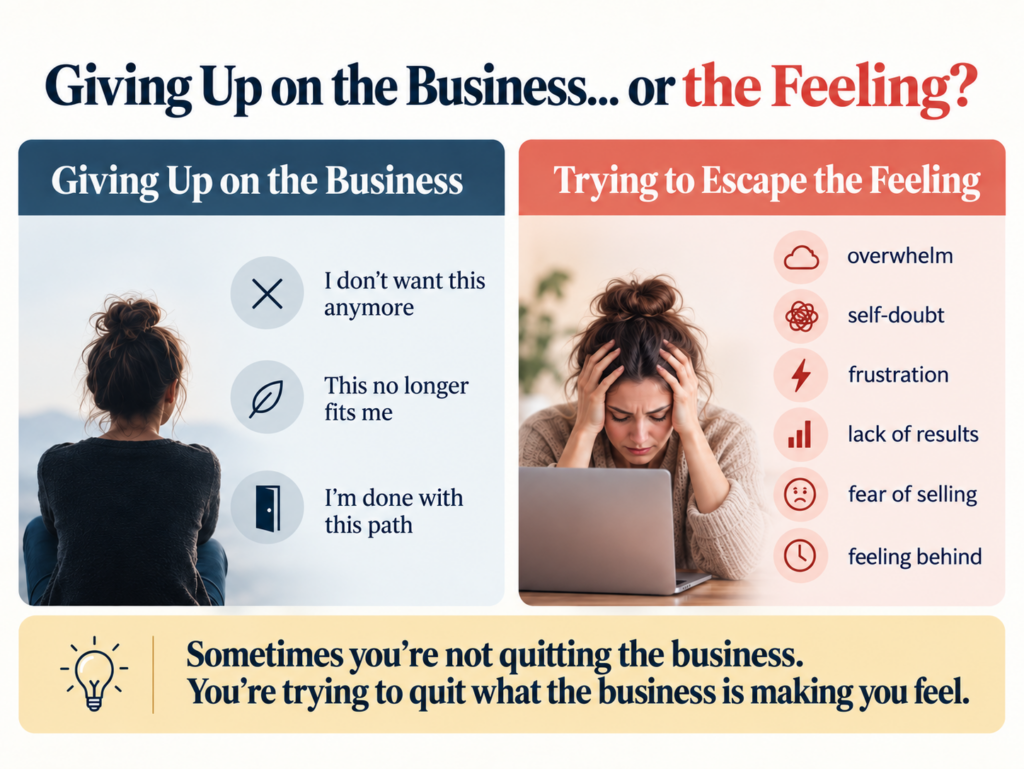
But before you quit the whole business, ask:
What exactly am I trying to quit?
The business?
The business model?
The product?
The strategy?
The platform?
The pressure?
The schedule?
The selling method?
The feeling of being overwhelmed?
The disappointment of slow results?
Years ago, I wrote about this idea because I noticed something important.
A lot of the time, when someone says:
“I want to quit my business.”
what they really mean is:
“I want to quit this part of my business.”
That’s worth figuring out before you throw the whole thing away.
You may not need to quit.
You may need to change something.
10. Stop Asking How to Get Motivated Again
If your pattern has become:
Stop.
Feel bad.
Get motivated.
Restart.
Stop again.
Then motivation is clearly not solving the problem.
You’ve already proven you can get motivated.
You’ve done it repeatedly.
The real question is:
What happens after the motivation wears off?
That’s where your system has to take over.
What do you work on?
What do you do when you only have 15 minutes?
What happens when life interrupts?
What do you do when you don’t get the result you wanted?
How do you handle self-doubt?
How do you resume after a bad week?
Those are much more useful questions than:
How do I get fired up again?
Because you don’t need to get fired up forever.
You need a way to keep moving after the fire dies down.
If This Keeps Happening, It May Be More Than Motivation
If you’ve stopped once because life got crazy, that’s one thing.
If you’ve stopped because you genuinely decided the business wasn’t for you, that’s another.
But if you’ve:
Started.
Stopped.
Felt guilty.
Come back.
Gotten motivated again.
Stopped again.
And repeated that cycle over and over…
That’s a pattern.
And patterns can be understood.
They can also be changed.
That’s exactly why I created UNSTUCK: The Comeback Workshop.
UNSTUCK is a 4-session on-demand workshop for home-business owners who are tired of starting, stopping, and starting over.
We look at what keeps knocking you off track, how your results may be affecting your belief in yourself, why waiting for life to change keeps you stuck, and how to build a realistic system for continuing to move your business forward.
Not a perfect system.
Not a system for somebody who has eight uninterrupted hours a day.
A system for real life.
What Should You Do the Next Time You Feel Like Giving Up?
First, don’t make a major decision in the middle of a bad day.
Give yourself a little space.
Then ask:
What am I actually trying to escape right now?
Is it disappointment?
Confusion?
Overwhelm?
Fear?
Lack of results?
A task you hate?
Something you don’t know how to do?
A life situation that genuinely needs your attention?
Then ask:
Is the business the problem, or is there a problem inside the business I need to solve?
That distinction matters.
Next, choose one meaningful move.
Not a giant comeback.
One move.
- Send the email.
- Follow up.
- Finish the page.
- Start the conversation.
- Make the offer.
- Ask for help.
- Learn the one skill you actually need.
Take the next step.
And if you really do need to step away for a while… step away.
Then come back when you can.
You don’t have to turn every interruption into the end of the story.
You’re Probably Not Starting Over
If you’ve stopped before, you may feel like you’ve wasted time.
Maybe you have. I certainly have.
But you’re not back at zero.
You’ve learned things.
You’ve tried things.
You’ve made mistakes.
You know more about yourself.
You know more about what works.
You know more about what doesn’t.
Even the stopping taught you something.
If you’re willing to look at it.
So no, I don’t think the answer is to beat yourself up for quitting again.
I think the better question is:
What is this pattern trying to teach me?
Because if you can figure that out…
you may not have to keep repeating it.
Frequently Asked Questions About Giving Up on Your Business
Why do I keep giving up on my business?
People often stop because of overwhelm, lack of results, self-doubt, unclear priorities, fear of selling, uncomfortable conversations, burnout, or real-life interruptions.
If it keeps happening repeatedly, look for the pattern that shows up right before you pull away.
Is it normal to want to quit your business?
Yes. Most business owners experience periods of doubt and frustration.
Wanting to quit doesn’t automatically mean you should.
It may mean there’s a specific part of the business, strategy, workload, or emotional pressure that needs to change.
How do I know if I should quit my business?
Ask whether you genuinely no longer want the business or whether you’re reacting to a temporary problem inside it.
Identify exactly what you want to stop before deciding on the entire business.
How do I stop giving up when I don’t see results?
Separate your results from your self-worth.
Look at whether you’re doing the right activities, getting enough visibility, generating leads, having conversations, making offers, and developing the skills you need.
Then look for small signs of progress that can give you useful feedback.
What should I do when I lose motivation in my business?
Don’t rely entirely on motivation. Identify one meaningful next action and take it.
Small movement can create feedback, proof, and sometimes renewed motivation.
Why do I keep starting and stopping my business?
Repeated starting and stopping can happen when the same trigger keeps returning, such as overwhelm, self-doubt, burnout, lack of clarity, disappointing results, or life interruptions.
Recognizing your trigger earlier can help you interrupt the pattern before a short pause becomes a long stop.
How do I get back into my business after giving up?
Don’t try to catch up on everything you missed.
Look at what matters now, choose one meaningful action, and resume from where you are.
You don’t need to recreate Day One.
Need Help Figuring Out Your Next Move?
If you know you need to get moving, but you’re staring at your business wondering what deserves your attention first, my free Daily Action Guide can help.
It’ll help you identify what matters most right now and turn it into one meaningful action you can actually take.
And if the bigger problem is that you keep stopping, coming back, and repeating the same cycle…
that’s what UNSTUCK: The Comeback Workshop was built for.
It's Your Time to SHINE!

Dr. Bob Clarke
Email: Bob@BobandRosemary.com
Join The Second Income Society
A free tribe for Busy Entrepreneurs
This post may contain affiliate links to products or services I trust. If you make a purchase using these links, I may receive a commission at no extra cost to you. Thank you for the support!
Recommended Resources To Jumpstart Your Business
The Stupid Simple Daily Action Guide For Busy Entrepreneurs - know what to do for your business every time you sit down at your computer... ahead of time!
UNSTUCK: The Comeback Workshop: A 4-session on-demand workshop for home-business owners tired of starting, stopping, and starting over. Discover what keeps derailing you and build a realistic system for consistent action.
How To Earn Your First $1000 Online - wouldn't it feel great to have more money coming IN each month than going OUT?
Crush Consistency NOW! - if you find yourself lacking consistency in your business, you must own this course!
The Second Income Society - a free tribe for busy entrepreneurs
The Part-Time Profit Machine - my signature course, a must-have resource for anyone building a business part-time.